

Colour Theory Without the Art School Jargon

Every new painter faces the same moment: you've got your models, your paints are laid out, and then the paralysing question arrives — what colours do I actually use? The box art is one option, but what if you want something your own? What makes a colour scheme work?
The answer lies in some basic colour theory — and it's much more approachable than it sounds. Mediocre Hobbies always emphasise this in their tutorials: a simple, well-chosen two or three colour scheme, executed consistently, will look far better than a complicated one done poorly.

The Colour Wheel — The Only Tool You Need
Primary colours — red, blue, yellow. These can't be mixed from other colours.
Secondary colours — orange, green, purple. Made by mixing two primaries.
Complementary colours — colours directly opposite each other on the wheel. Red and green. Blue and orange. Purple and yellow. These create maximum contrast when placed next to each other.
Analogous colours — colours next to each other on the wheel. These create harmony and feel cohesive together.
Three Schemes That Always Work
Complementary
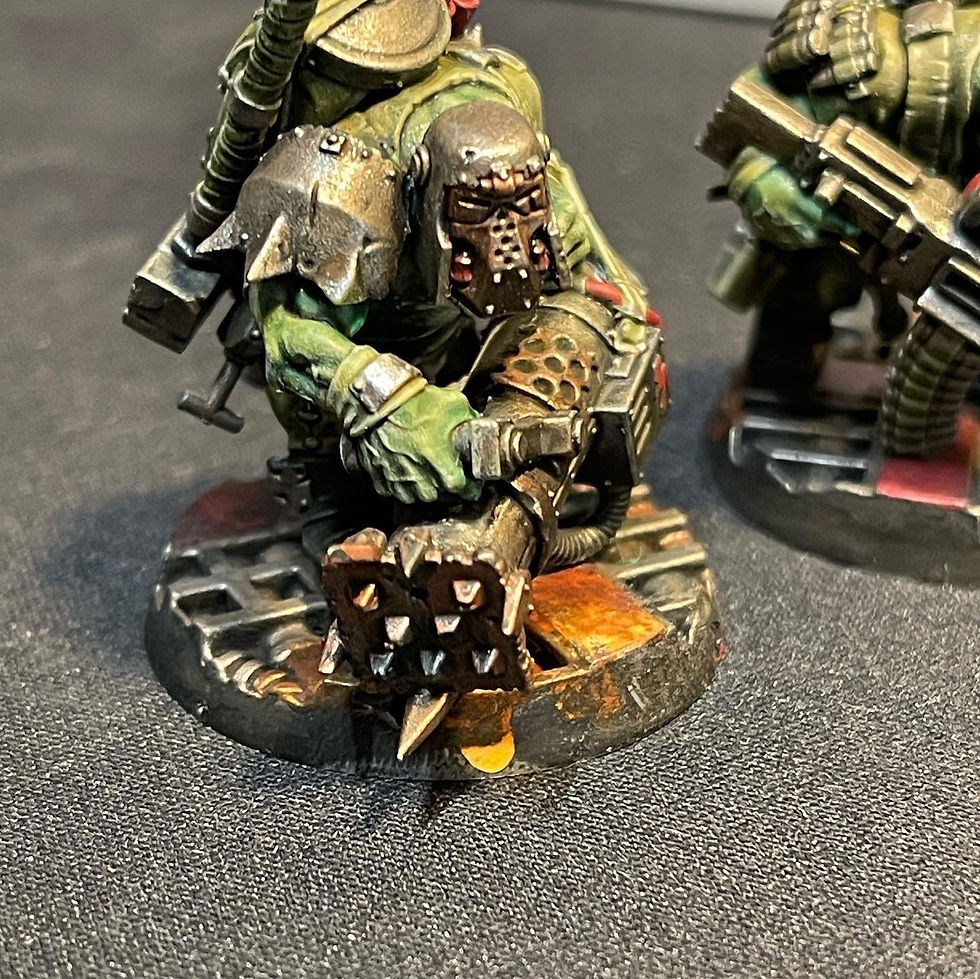
Pick one main colour and use its opposite as the accent. Blue armour with orange details. Red cloth with green basing. High contrast, visually striking. Used by Ultramarines, Blood Angels, and many official faction schemes.
Analogous
Pick two or three colours that sit next to each other on the wheel. Blue, blue-green, teal. Red, orange, amber. Feels cohesive and naturalistic — great for organic armies like Tyranids or Sylvaneth.
The Triangle
Pick three colours equally spaced on the wheel. One dominant, one secondary, one small accent. This gives variety without chaos — the approach many experienced painters use instinctively.
The Rule of Thirds — Proportion Matters
Once you've picked your colours, decide how much of each to use. A useful approach: roughly 60% dominant colour, 30% secondary colour, 10% accent. The accent colour is your pop — use it on gems, eyes, weapon effects, anywhere you want the eye to go.
Warm vs Cool — The Secret Weapon
Even within a limited palette, you can add enormous depth by mixing warm and cool tones. Warm colours (reds, oranges, yellows) seem to leap forward visually. Cool colours (blues, greens, purples) seem to push back. Painting shadows in cool tones and highlights in warm tones creates a natural-looking depth that mimics real light.
This is why Agrax Earthshade (a warm brown) makes skin tones look so naturalistic — skin is a warm colour family. And why Nuln Oil (a cool black) makes metal look clean and cold. The warmth and coolness are doing work you might not even consciously notice.
You don't need to understand all of colour theory to use it. Pick complementary colours, use them in a 60/30/10 ratio, and contrast your army against your basing. That's 90% of what the pros are doing.
Always consider your basing when planning a colour scheme. If your bases will be brown earth and green grass, don't make your army predominantly brown and green — they'll disappear. A contrasting army colour like deep blue, bone, or red will pop against natural basing.
Next up: Blog 7 covers the subtraction method — painting backwards for more natural-looking results. Publishing Wednesday 27 May 2026.


Comments