

No Mates? No Problem — How Joining a Club Changed Everything

Let's be honest about something that doesn't get said enough: loneliness is hard. It's one of those things that sneaks up on you — after a move to a new area, a change in job, a relationship ending, or simply the gradual drift of old friendships. And in a world where we're more "connected" than ever through social media, actually feeling connected to real people in a real place can feel harder than it should.
What's this got to do with little plastic soldiers, you ask? More than you might think.

The Loneliness Nobody Talks About
The Mental Health Foundation has highlighted that loneliness isn't just an uncomfortable feeling — it's a genuine threat to our wellbeing. A poor sense of community belonging robs people of one of their most vital protective factors against poor mental health. And yet most of us struggle to admit when we're lonely, because it feels like a failing. Like we should be better at this whole "being human" thing.
The truth is that making new friends as an adult is genuinely hard. Gone are the days of school corridors or university halls where friendships formed naturally through proximity and shared experience. As adults, we have to be more intentional about it — and that can feel terrifying.
Where Shared Passion Changes Everything
Here's where tabletop wargaming — and clubs like the Wildlings — offer something genuinely special. When you walk into a club night, you already have something in common with every single person in the room. You don't have to make small talk about the weather or struggle to find common ground. You're all there for the same reason: the hobby you love.
That shared passion acts as an icebreaker that never runs out. Conversations about army lists, paint schemes, the latest codex, or whether a particular tactical choice was inspired or catastrophic — these flow naturally. And before long, those conversations become something more. They become the foundation of real friendships.
As one wargaming community writer put it: conversations might start with sharing pictures of painted minis or debating an exciting new release, but once people are already talking, it makes opening up about more serious things easier too. The game brings you to the table. The people keep you coming back.
A Purpose in the Room
One of the most underrated aspects of a wargaming club is that it gives social interaction a purpose. If social anxiety is something you struggle with, the idea of walking into a room full of strangers just to "chat" can be paralysing. But walking into a room to play a game? That's different. There's a reason to be there. There's a structure. There's a shared focus.
Psychologists have noted that the benefit of wargaming is that there is a purpose to being together — a shared desired experience — unlike trying to socialise without any parameters. That structure makes it easier to engage, easier to relax, and easier to simply be yourself.
You can focus on what's happening on the table rather than worrying about the social dynamics of the room. And in doing so, the social dynamics often take care of themselves.
The Wildlings: Built on Belonging
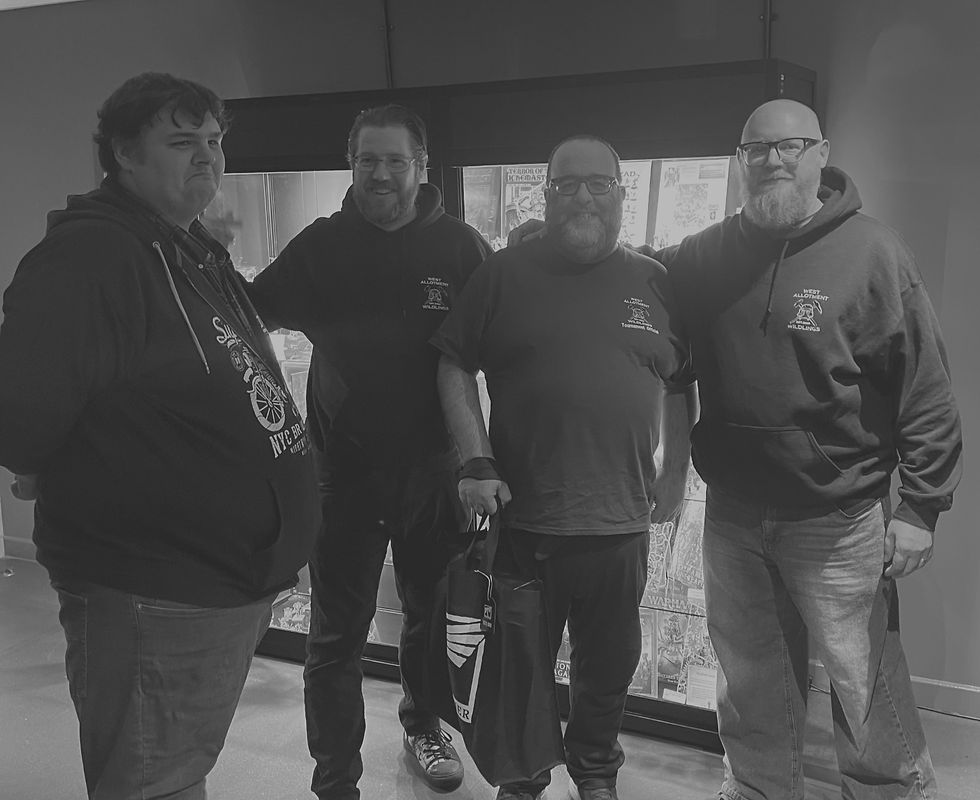
West Allotment Wildlings was founded as a Community Interest Company with inclusivity and participation at its heart — providing a space to play and paint for all ages. That's not just a tagline. It shapes everything about how the club operates.
We've seen it time and again. Someone turns up to their first club night — a little nervous, maybe not sure if they'll fit in — and within an hour they're deep in conversation about their army, getting tips from a veteran player, or laughing over a spectacular dice roll that turned a game on its head. The nerves fade. The community takes over.
It doesn't matter whether you're a seasoned tournament player with a perfectly painted army, or someone who's just clipped their first model from the sprue. At the Wildlings, you belong.

Something to Look Forward To
There's a psychological concept called behavioural activation — the idea that having things to look forward to is genuinely good for our mental health. It gives our week shape and purpose. It gets us out of the house. It reminds us that there are good things ahead.
A regular club night does exactly this. Knowing that on a given evening you'll be pushing miniatures across a table with people who get it — who share your enthusiasm and won't look at you strangely for caring deeply about which colour you based your Astartes — is a genuinely uplifting thing to have in your week. It sounds simple. But simple things matter.
Real Stories, Real Impact
Tom Bulpit, a counsellor and Warhammer player, returned to the hobby during the grief and isolation of the Covid lockdowns after losing his mother. He described how getting back into Warhammer 40,000 gave him the outlet he needed to process his grief, opened up new friendships, and provided opportunities he hadn't imagined. He went as far as saying it might have saved his life.
Katie Foad, a presenter with TableTop Tactics, described how painting miniatures at her lowest point forced her to focus, leaving less room for anxious thoughts. She found that the Warhammer community was flooded with people sharing similar stories — people who had found in the hobby and its community something they couldn't find elsewhere.
These aren't unusual stories. They're the kind of stories that happen every week in clubs just like ours.
Come and Find Your People
If any of this resonates with you — if you've been thinking about getting into the hobby, or back into it after a break, or you're just looking for somewhere to belong — we'd love to see you at West Allotment Wildlings.
You don't need a fully painted army. You don't need years of experience. You don't even need to know the rules particularly well. You just need to turn up. The rest has a habit of taking care of itself.

Keep an eye on our Events page for upcoming club nights, league seasons, and open days. And follow us on Facebook at West Allotment Wildlings for all the latest news, hobby updates, and community chat. We'll see you across the table.


Comments